How It Works, Costs, Laws & How to Choose the Right Coverage
If you’ve ever searched “insurance near me” or wondered why your premiums feel like a moving target, you’re not alone. Most Canadians only learn about insurance when something goes wrong—a car accident, a burst pipe, or a family crisis.
This guide is written to fix that. No legal jargon. No corporate fluff. Just a clear, honest explanation of how insurance works in Canada in 2026.
Quick Answer (TL;DR)
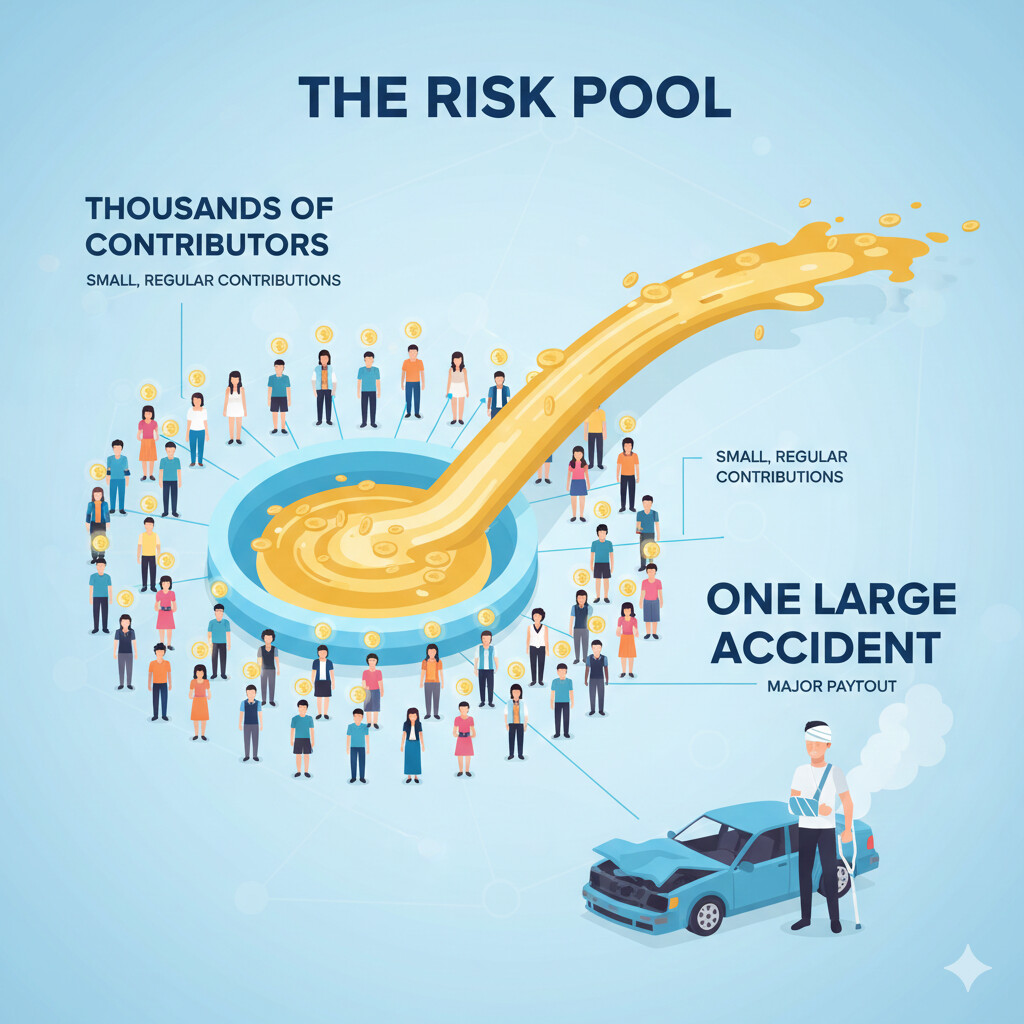
- The Core: Insurance is a risk-sharing system—you pay small amounts to avoid huge, life-altering losses.
- The Process: You pay a premium, choose a deductible, and receive a legal policy.
- Regulation: Insurance is governed by provincial law (The Insurance Act).
- Mandatory vs. Optional: Car insurance and Workers' Comp are mandatory; home and life are technically optional but often required by banks or landlords.
- 2026 Pricing: Costs vary by province, age, and risk. Alberta and Ontario currently see the highest auto rates.
- The Help: Brokers compare dozens of companies for you; Agents represent just one.
- The Risk: Choosing the wrong policy can cost you tens of thousands when you need it most.
Who This Guide Is For
This article is designed specifically for you if you are:
- Buying insurance for the first time in Canada.
- Confused by terms like "Premiums," "Deductibles," and "Exclusions."
- Wanting to save money legally without losing protection.
- Starting a family, a business, or are new to the country.
1. What Is Insurance? (In Plain English)
Insurance is a financial protection system. You pay a small, predictable amount each month so that if something catastrophic happens, you aren't financially ruined.
Real-Life Example:
- Sarah lives in Vancouver. Her condo’s water pipe bursts, flooding 4 units.
- Total Repair Bill: $48,000.
- With Insurance: Sarah paid her $1,000 deductible; her insurer paid the other $47,000.
- Without Insurance: Sarah would be paying off that debt for a decade.
2. How Does Insurance Work?
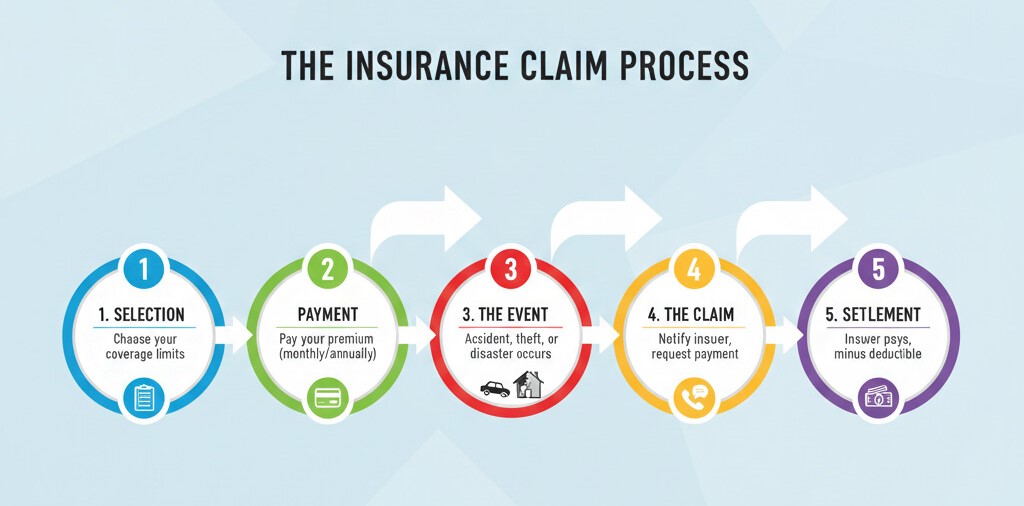
At its core, the process follows five steps:
- Selection: You choose the coverage limits you need.
- Payment: You pay a premium (monthly or annually).
- The Event: An accident, theft, or disaster occurs.
- The Claim: You formally notify the insurer to request payment.
- Settlement: The insurer pays the bill, minus your deductible.
Key Terms You Must Understand
| Term | Meaning |
| Premium | Your "subscription fee" to the insurance company. |
| Deductible | Your "share" of the cost before insurance starts paying. |
| Policy | The legal contract detailing what is and isn't covered. |
| Coverage Limit | The max amount the insurer will ever pay (e.g., $2M Liability). |
| Claim | Your official request for the company to cover a loss. |
3. Insurance Deductible Meaning (Why It Matters)
The deductible is the amount you pay out-of-pocket for a claim. In 2026, many Canadians are raising their deductibles to lower their monthly bills.
| Deductible Amount | Monthly Premium | Financial Risk Level |
| $250 | Higher | Low Risk (Easy on savings) |
| $1,000 | Medium | Medium Risk (Standard) |
| $2,500 | Lowest | High Risk (Requires emergency fund) |
Rule of Thumb: Only choose a high deductible if you have that exact amount sitting in a "rainy day" bank account right now.
4. What Is an Insurance Premium?
Your premium is the price of your policy. In 2026, insurers use AI-driven "Risk Scoring" to determine this. Factors include:
- Location: High-theft or flood-prone areas pay more.
- Experience: Your age and years of clean driving/claims history.
- Credit Score: Used in some provinces (like Alberta orOntario) to predict risk.
- Coverage Type: The more "extra" protection you add, the higher the premium.
5. What Is an Insurance Policy?
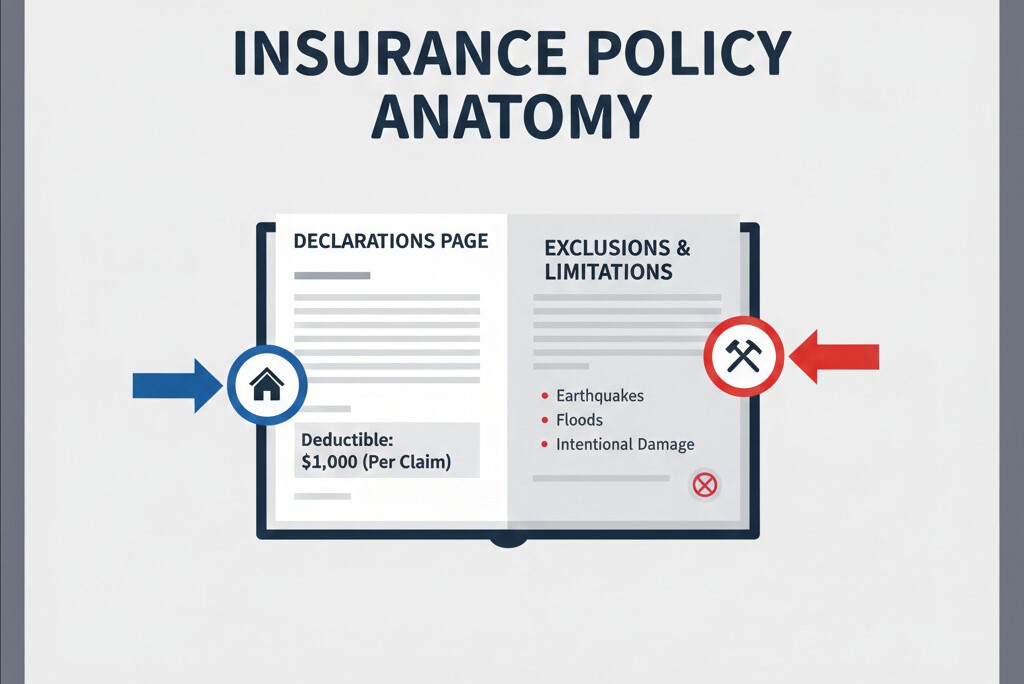
Your policy is a legally binding contract. It is not just a receipt. It defines:
- Inclusions: Exactly what is covered (e.g., Fire, Wind, Theft).
- Exclusions: What is not covered (In 2026, many standard policies exclude "Overland Flooding" unless added as a rider).
- Statutory Conditions: Your legal duties (like reporting a move or a new roommate).
6. Insurance Laws & Regulators in Canada
Insurance is not federal; it is regulated by each province.
- In British Columbia: Regulated by the Insurance Council of BC (licensing) and BCFSA (watchdog). Laws include the Insurance Act and Motor Vehicle Act.
- In Ontario: Regulated by FSRA (Financial Services Regulatory Authority).
- In Alberta: Regulated by the Alberta Insurance Council (AIC).
7. Is Insurance Mandatory in Canada?
| Type | Is it Mandatory? | The Fine Print |
| Car Insurance | YES | You cannot legally drive without at least Third-Party Liability. |
| Workers' Comp | YES | Mandatory for almost all businesses with employees. |
| Home Insurance | NO* | Not by law, but Banks require it to give you a mortgage. |
| Renters Insurance | NO* | Not by law, but most some Landlords require it in the lease. |
| Life Insurance | NO | Entirely optional for personal family planning. |
8. How Much Does Insurance Cost in Canada? (2026 Estimates)
Note: Prices have risen roughly 12% since 2024 due to high repair and construction costs.
| Insurance Type | Avg. Monthly Cost |
| Car Insurance | $120 – $350 |
| Renters Insurance | $20 – $45 |
| Home Insurance | $90 – $280 |
| Life Insurance | $25 – $120 |
9. How Much Is Car Insurance? (The Provincial Gap)
In 2026, your location is the #1 price driver. Ontario and Alberta drivers typically see the highest rates in the country.
| Ontario (GTA): | $250 - $400+/month (High fraud and density) |
| BC (Lower Mainland): | $150 - $250/month (Lowered by ICBC's "No-Fault" model). |
| Quebec: | $80 - $130/month (Public/Private hybrid system). |
10. How Much Is Renters Insurance?
Renters insurance is often cheaper than a Netflix or Spotify subscription. For $20–$30 a month, you get:
- Content Coverage: If your laptop or furniture is stolen.
- Liability: If you accidentally start a kitchen fire that damages the building.
- Additional Living Expenses: If you have to stay in a hotel because your apartment flooded.
11. How Much Is Life Insurance?
Life insurance cost is primarily a "Health & Age" game.
- Term Life: Affordable. A 30-year-old non-smoker can often get $500,000 in coverage for ~$25/month.
- Whole Life: Much more expensive, as it builds cash value.
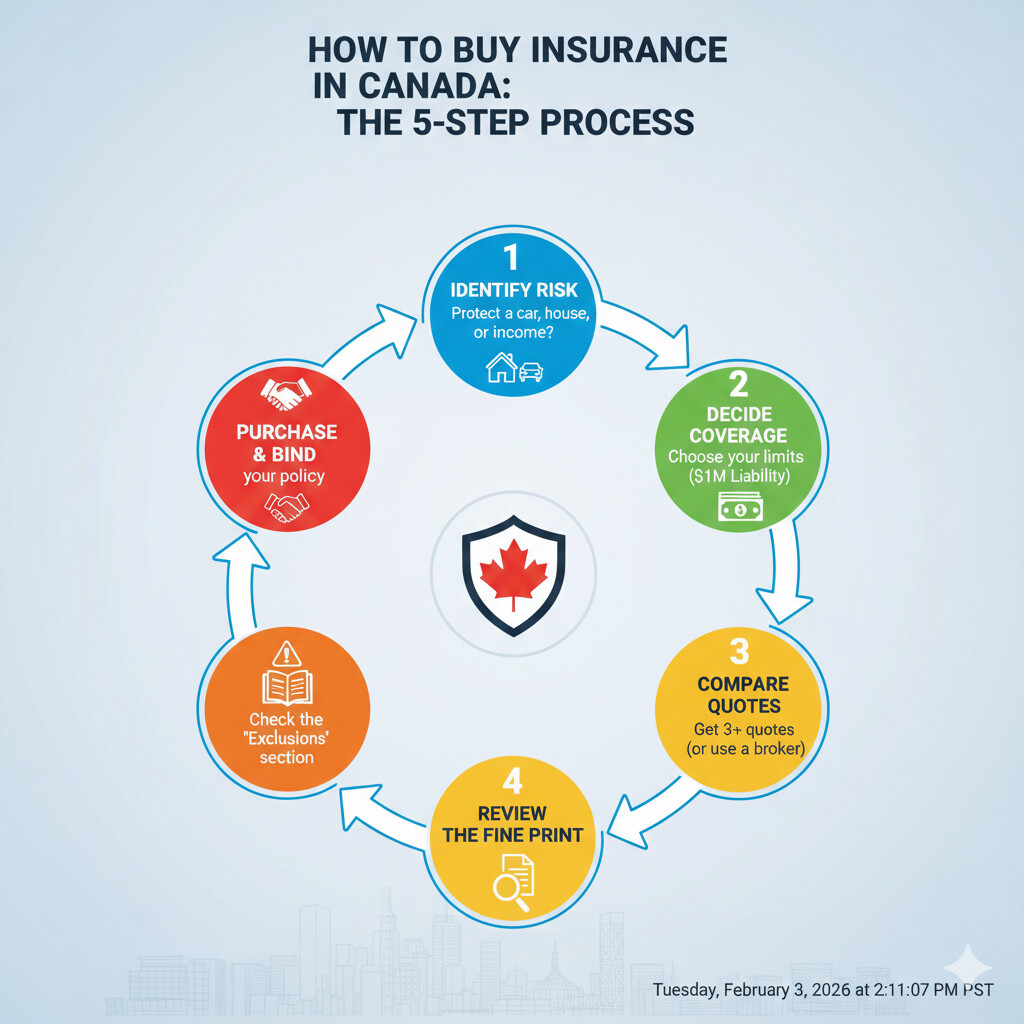
12. How to Buy Insurance in Canada (The 5-Step Process)
- Identify Risk: Do you need to protect a car, a house, or your income?
- Decide Coverage: Choose your limits (e.g., $1M or $2M Liability).
- Compare Quotes: Get at least 3 quotes (or use a broker).
- Review the Fine Print: Look specifically for the "Exclusions" section.
- Purchase & Bind: Once you pay, the insurance is "bound" and active.
13. How to Get a Quote for Car Insurance
To get an accurate 2026 quote, you need:
- Driver’s License Number: To check your driving record.
- VIN (Vehicle Identification Number): To check the safety rating of the car.
- Daily Mileage: How far you drive to work.
- Claims History: Proof of how many years you've been "accident-free."
14. Insurance Broker vs. Insurance Company
| The Broker | The Insurance Company (Direct) |
| Shops dozens of companies for you. | Only sells their own brand (e.g., Allstate, Belair). |
| Paid via commission from the insurer. | Paid via salary/commission. |
| Can move your policy if rates go up. | You have to leave and start over if rates rise. |
15. How Insurance Brokers Make Money
Many people think brokers are more expensive. They are not.
Brokers are paid a commission (usually 10–20% of the premium) by the insurance company as a "finder's fee." You pay the same premium whether you spend 4 hours calling companies yourself or 5 minutes talking to a broker.
16. Common Insurance Mistakes (To Avoid in 2026)
- Underinsuring your home: Ensure your policy covers "Replacement Cost" at 2026 labor rates, not 2010 rates.
- Ignoring Exclusions: Assuming "Full Coverage" includes everything (it never does).
- Choosing Cheapest Only: A cheap policy often has high deductibles and very low "hidden" limits.
- Lying on Applications: This is "Insurance Fraud," and it will result in your claim being denied.
17. Internal Linking & Next Steps
Deepen your knowledge by visiting our specific links:
Get List of Insurance Companies in Canada
18. FAQs
Q. Is insurance regulated?
A. Yes, by provincial bodies like FSRA (ON) and BCFSA (BC).
Q. Can they deny my claim?
A. Yes, if you broke the law (DUI) or the event is an exclusion.
Q. Is a broker cheaper?
A. Usually, because they find discounts you didn't know existed.
Final Thought:
Insurance is the bridge between a "bad day" and a "financial disaster." Take 10 minutes to review your policy today—before you actually need it.